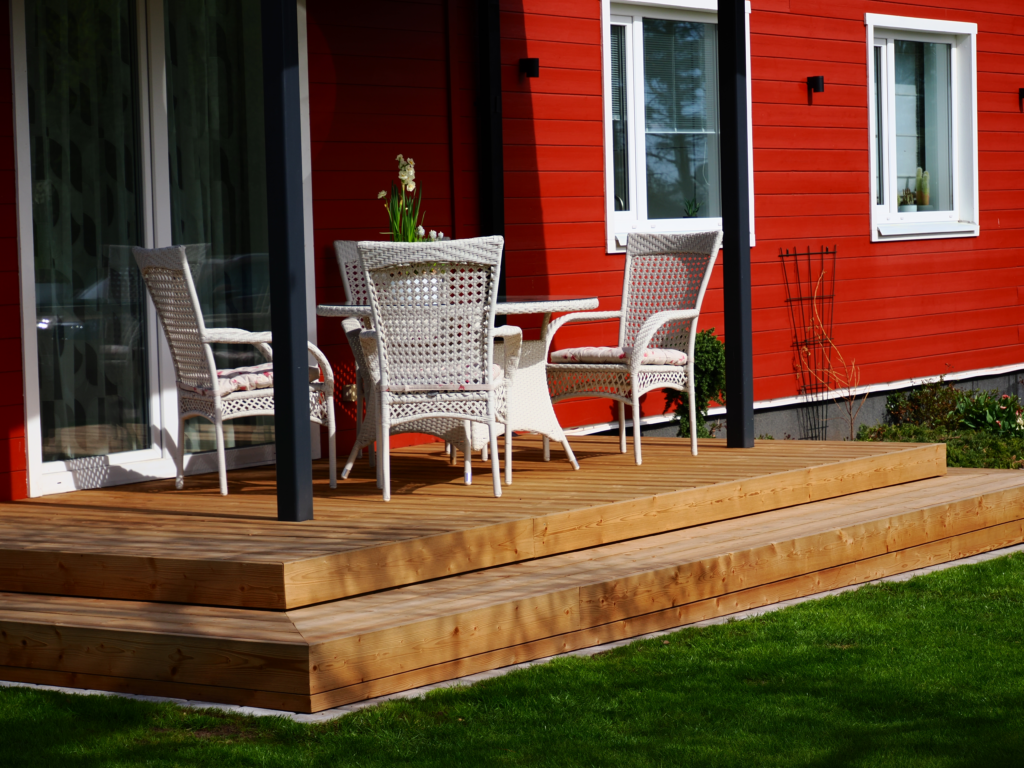
When planning to build a deck, many homeowners, builders and designers quickly face the same question: should you choose thermowood or pressure-treated decking? Both materials are widely used in Nordics and perform well in outdoor conditions, but they differ significantly in terms of properties, appearance and maintenance requirements.
The right choice depends largely on where the deck will be built, how much maintenance you are prepared to carry out and the overall look you want to achieve. The same applies to garden construction projects, where garden timber, fence posts and fence boards must withstand year-round moisture, temperature fluctuations and everyday use.
What Makes Thermowood Different from Pressure-Treated Wood?
The main difference between thermowood and pressure-treated wood lies in the way the timber is processed.
Pressure-treated decking undergoes a treatment process in which preservatives are forced deep into the wood under pressure. This improves its resistance to moisture, mould and wood-damaging organisms. As a result, pressure-treated timber is commonly used for deck framing, fence posts and other structural elements that are regularly exposed to moisture or come into direct contact with the ground.
Thermowood, on the other hand, is modified using high temperatures without the addition of chemicals. This thermal modification changes the wood’s internal structure and significantly reduces its moisture absorption. As a result, thermowood decking reacts less to changes in weather conditions, expands and contracts less and retains its shape more consistently over time.
The visual difference is also easy to notice. A thermowood deck typically has a rich brown colour that highlights the natural grain of the timber. Pressure-treated decking usually has a lighter, more technical appearance and is often chosen for practical applications where durability and low maintenance are the main priorities.
Which Decking Is Best for Different Applications?
If you’re building a deck for a high-traffic area, such as a family home’s outdoor living space, a front entrance or a frequently used patio, pressure-treated decking is often the most practical choice. It performs well in locations exposed to moisture, mud, moving outdoor furniture and everyday wear.
A thermowood deck, on the other hand, is an excellent option when appearance and dimensional stability are just as important as durability. Thermowood is widely used for modern homes, large open decking areas and projects where the deck forms an important part of the property’s architectural design.
The size and location of the project also influence the choice of material. A small balcony or a simple patio at a summer house often benefits from thermowood decking, as the rich colour, clean profile and natural appearance become more noticeable on smaller surfaces.
The deck structure itself also plays an important role. In many projects, pressure-treated construction timber is used for the deck frame, even when thermowood decking boards are chosen for the visible surface. This combination provides a durable supporting structure while achieving the desired visual finish.
It is also worth considering how much sunlight the deck receives throughout the day. On south-facing or fully exposed areas, decking boards absorb more heat and darker thermowood can become noticeably warmer during summer than lighter pressure-treated timber. Ventilation is equally important. Decks surrounded by dense landscaping or fencing tend to dry more slowly after rain, making proper airflow and moisture drainage essential for long-term durability.
How Long Does Pressure-Treated Garden Timber Last?
When installed correctly and properly maintained, pressure-treated garden timber can last for decades, even in demanding Nordic weather conditions. Its lifespan depends on several factors, including where it is used, the level of moisture exposure, ventilation and whether the timber comes into direct contact with the ground or standing water.
For example, pressure-treated fence boards, timber fence posts and railing components generally last much longer when the structure is well ventilated and rainwater can drain away efficiently. The same principle applies to decks. Even the highest-quality decking boards require a well-designed substructure and sufficient airflow beneath the deck to maximise their service life.
The two materials also differ in terms of maintenance. Pressure-treated decking gradually develops a grey patina over time and may require periodic cleaning, staining or oiling, particularly on surfaces exposed to strong sunlight and constant moisture. Thermowood maintains its shape exceptionally well, although its rich brown colour will naturally weather to an elegant silver-grey if it is left untreated without protective decking oil.
Which Timber Solution Should You Choose?
There is no single answer, as both materials offer distinct advantages. If your priorities are practicality, structural strength and lower maintenance, pressure-treated decking is a reliable and cost-effective choice. If appearance, dimensional stability and the natural character of the wood are more important, thermowood is often the preferred option.
In many cases, the best solution is to combine both materials. Pressure-treated timber is commonly used for the deck frame and other load-bearing elements, while thermowood is selected for visible surfaces such as decking boards, railings and other architectural details. This approach combines long-lasting structural performance with an attractive finished appearance.
Ultimately, the quality of a deck depends not only on whether you choose thermowood or pressure-treated decking, but also on selecting the right material for the specific project, expected level of use and surrounding environment. Well-chosen decking boards, a properly designed deck structure and quality construction details will create an outdoor space that performs reliably in the Nordic climate for many years.
Whether you’re planning a modern thermowood deck, a practical pressure-treated decking solution or a complete garden construction project, contact us. We’ll help you choose the right timber products for your project and ensure they are suited to both your home and the demands of the Nordic climate.