Things to consider
Our exterior wood cladding offers a compelling combination of aesthetics, durability, and sustainability, making it a strong candidate for both residential and commercial façades. Puidukoda specializes in premium Nordic softwoods — mainly spruces and pines — which are valued for their strength, workability, and visual warmth.
Read the full manual for external cladding and industrially painted cladding here.
Type of wood
External cladding is mostly made of spruce, since the density of spruce is more uniform and durable than that of pine and thus volume fluctuations caused by moisture occur less frequently in spruce. Thanks to this, the service life of external cladding and finishing is longer.
As spruce cells close during the drying process and this increases the biological durability of wood, spruce does not need pre-impregnation with wood preservative. For instance, during industrial painting, cladding is covered with priming paint as the first layer
Planed or fine-sawn cladding?
Take your time to consider whether you want to use planed or fine-sawn external cladding, since both have their pros and cons.
Fine-sawn cladding is more practical, as when painting, the more porous fine-sawn surface is able to absorb up to 60% more paint. Paint sticks better to the surface and it penetrates the pores of the wood more deeply, prolonging the service life of the paint layer of fine-sawn cladding up to two times (no need for such frequent maintenance painting). Besides paint, dust and dirt sticks well to the surface of fine-sawn cladding, and cleaning a façade is not an easy job. Thus, if the façade to be finished with cladding is located in a place where it gets quickly dirty and needs frequent cleaning, you should consider planed cladding, which can be easily cleaned with special agents meant for cleaning cladding (do not use pressure washing).
Although the paint coating will need more frequent refreshing, maintenance of the façade is simpler.
Profiles and widths
The shape or profile of the external cladding should be selected based on the location and architecture of the building. In general, narrower cladding with an emphasised profile gives more etherealness to the more complex and/or smaller façade surfaces, whereas a wider and calmer profile is ideal for covering larger façade areas. For renovating older buildings, we recommend using profiles characteristic of the era.
Recommended thicknesses
The thicker the external timber cladding, the more uniform its moisture regime (volume fluctuations caused by moisture are smaller). Thus, a façade made of thicker cladding is more stable and has an extended service life. Pursuant to the Nordic standards, the minimum recommended thickness of external timber cladding is 21 mm.
A thinner external cladding may be used, but in this case you should consider the shorter service time of the façade and the increased risk due to problems caused by more frequent and bigger volume fluctuations (cracks, paint coating damages, bending of cladding, etc.).
Socle and eaves
Regardless of the quality of surface finishing, a wooden façade is especially sensitive to moisture, the extreme expressions of which are rain falling at an angle and water splashing up from the ground. To prolong the service life of the wooden façade, the height of the socle should be over 300-500 mm and the width of the eaves over 600 mm.
The service life of a façade whose eaves are shorter and/or whose socle is lower is certainly significantly shorter and will require more frequent maintenance (maintenance painting of the paint coating). This type of façade is considered a façade in extreme conditions and the cladding manufacturer (and the manufacturer of industrially painted cladding) cannot be held responsible for the service time of this type of façade.
How to calculate material consumption?
Depending on the architectural characteristics of the building, material consumption can be calculated in two ways. The simplest way is to calculate the gross area of the façade without any deductions from the openings and to order the cladding accordingly. If the building has many windows or doors, calculate the net area of the façade (windows and doors deducted) and upon ordering add spare space to the net area of at least 5%, preferably 10%.
Cutting and fitting the cladding results in considerable loss, which should be taken into consideration when ordering because the later acquisition of the additional quantity is troublesome to both the buyer and the seller (especially for the manufacturer of industrially painted external cladding).
Installation
Aeration gap, base batten, base batten pitch and thickness
An aeration gap is left under the timber façade to ensure sufficient aeration and drying of external timber cladding wetted due to weather conditions and to let out moisture evaporated through the walls of interior rooms. The width of the aeration gap should be at least 22 mm, the recommended width is even 25 mm. To provide ventilation, the aeration gap should be open from above and below and air should move freely within the entire area.
In the case of horizontal cladding, the aeration gap can be created with the base battens meant for fixing the cladding. To ensure sufficient fixing of the Aeration gap, the maximum pitch of the base battens should be 600 mm.
In the case of vertical cladding, crosswise or double battens should be built to ensure sufficient aeration (first install the lower layer vertically to ensure aeration and the other layer horizontally to create fixing places for vertical cladding). 3
Fastening fixtures and fastening
Regarding suitable fastening fixtures, use hot galvanised nails or stainless-steel screws. If you want to reduce the bending risk of cladding, we recommend using nails with better hooking properties (for instance rectangular or riffled).
You must definitely not use normal construction nails for installing external timber cladding, since nailing areas will quickly start to corrode. The length of a fastening fixture should be such that it extends into the base batten by at least 1.5 times the board thickness.
During fastening, be careful not to damage the paint coating. When using a nail gun, set the impact strength so that the nails do not get too deep in the board, since water may start accumulating in the created hollow (however, the nail head must not be left out).
In order to avoid cleaves, do not fasten boards too close to the end – a safe distance is 7-10 cm. If you need to fasten close to the end, the holes must be pre-drilled.
Profile boards should not be fastened from closing, but from each nailing spot with two nails from the top side of the board (from the top of the profile to avoid breaking the tongue and groove). This is done to prevent the cladding from bending.
Timber should also be fixed with two nails from top of the board on both sides, depending on the board width, from a distance of 1.5- 2.5 cm.
End and corner connections and joints
For corner connection, we recommend using a corner connection with covering boards (leave a ventilation gap between the ends). Do not make dense cut corner connections. When water penetrates between a dense corner connection, moisture cannot be ventilated freely and may cause damages.
Joints must always be done on the base batten. The sawn ends of the boards must be painted as moisture is emitted and absorbed most intensively from the ends (lengthwise). After installation, cover nailing areas with paint.
Well-installed gutter channels, discharge pipes, window off-sets and steel sheets ensure the long service life of a wooden façade. Painted external cladding should be handled with extra care to prevent any mechanical damage, as the paint layer is still not fully hardened and is prone to scratches and damage.
Maintenance
Maintenance paint finishing
Depending on the paint type used, the first maintenance painting of industrially painted cladding should be performed after 3-7 years in the case of glaze paints and after 7-15 years in the case of topcoat.
The frequency of maintenance painting depends on several circumstances. In addition to the paint type used, other important factors are whether the cladding is planed or fine-sawn, whether the colour shade is bright or pastel, whether the building is located on a coast with a harsh climate and salty sea air, etc.
In the case of glaze paints, obvious signs are fading colour shade and/or uneven patching, cracking and flaking.
If you use topcoat, the paint coating usually wears off evenly and becomes thin and knots become visible from under the paint coating. Before maintenance painting, clean the façade carefully, removing all loose dirt and dust. Mould spots must be pretreated with mould remover, then rinsed and allowed to dry. The moisture level of timber when painting must be below 20%, temperature at least +5 °C and relative air humidity below 80%. Avoid painting in direct sunlight, otherwise drying is too intensive and as a result the paint coating is less durable. Before painting, stir paint carefully. We advise you to estimate the paint quantity so that one container will be enough for one work area. This is to avoid shade differences between different containers (if you want to paint larger areas, we recommend mixing paint from several containers before you start working).
Resin exudation
The temperature of the façade exposed to sun light increases and resin in the timber is exuded on the board surface. As the paint coating is waterborne and lets moisture through, resin mostly exudes through a paint coating without damaging it.
Resin exuded on the surface should be left until it has hardened and when the resin flow has stopped and the resin has hardened, it can be removed with a nylon or natural brush.
For final removal of all resin stains, use methyl spirits and cloth but be careful not to damage the paint layer. If the paint layer gets dirty or damaged during cleaning, improve the paint coating immediately. Exudation of resin during use is a natural phenomenon of a wooden façade and is not considered a defect.
Mechanical damage
Mechanical damage to the material and/or paint layer is a natural phenomenon of a timber façade and is not a production fault. When such damage is detected, it should be improved as quickly as possible in order to prevent the damage from spreading further.
Bring warmth, durability, and timeless design to your interiors with our high-quality spruce and pine paneling. Whether for walls, ceilings, or accent features, we provide guidance and products that ensure lasting beauty.
About Puidukoda
Puidukoda was founded in 1997 in Southern Estonia. Our main activity is the production and marketing of quality value-added softwood planing materials such as Nordic spruce and Nordic pine. Puidukoja has modern and flexible fully automated production lines (from sorting to sawing, planing and thermofoiling) with a production capacity exceeding 225,000 m³ per year. In addition, we offer several post-processing options such as: painting, cabling, end-matching and impregnation.
With a strong presence in international markets, Puidukoda caters to a diverse clientele. Our products are designed to meet the varying needs of customers across Europe and beyond, ensuring reliability and satisfaction.
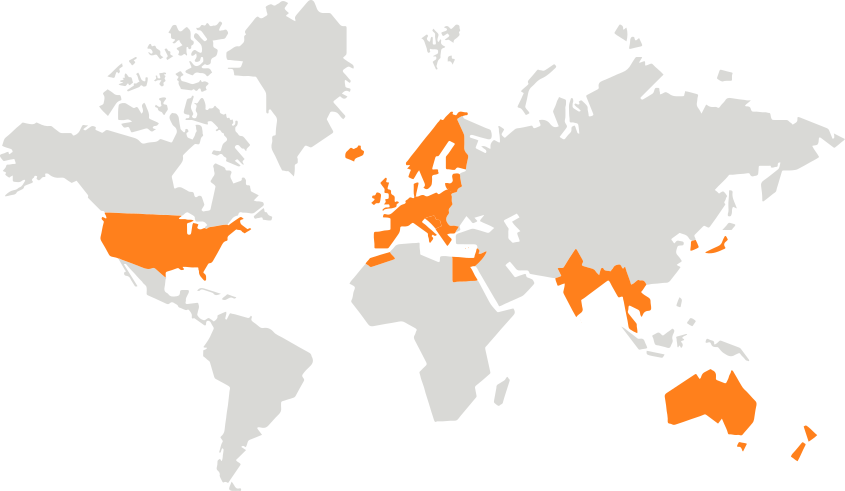
Our products are available through an extensive network of official resellers, ensuring accessibility and excellent customer service. Find your nearest reseller and explore our premium wood products today. Contact us for more information.