Bring warmth, durability, and timeless design to your interiors with our high-quality spruce and pine paneling. Whether for walls, ceilings, or accent features, we provide guidance and products that ensure lasting beauty.
Things to know about interior panelling
Before you order interior panelling, it is important to think about a few key questions. This helps to make sure you choose the right option for you.
You can take a look of Puidukoda’s full interior panelling manual here.
Pine vs Spruce
When selecting interior panelling, the different properties of spruce and pine should be kept in mind.
Pine timber is darker and reddish, changes over time and becomes even darker due to UV radiation. This can be compensated for by surface finishing containing UV protection, but not entirely.
As pine heartwood is reddish in colour and sapwood is lighter, pine timber is multicoloured by nature with a red-yellow pattern of varying widths. There are less knots than in spruce. But the knots are larger in diameter, often with black knots and bark-ringed knots. Whole black knots and bark-ringed knots are unavoidable in pine solid wood and are not considered defects, only knotholes or dead knots are considered defects. Pine fits well in its natural form (or finished with non-tinted varnish) or with white semi-transparent finishing in larger or bright spaces where this dark tone does not have an oppressive effect. Pine is also suitable for finishing with a topcoat as pine knots are less dense and therefore do not crack during drying and subsequent processing.
Consequently, after finishing with the topcoat, the pine paneling has significantly fewer noticeable surface defects.
Spruce wood has a lighter tone and retains its color for a longer period of time, yellowing only slightly (this can be avoided with surface finishing containing UV protection). Spruce has more knots than pine, but the knots are neutral in tone, smaller and there are very few or no black knots (pearl knots) and bark-ringed knots. Spruce as a light wood fits well in its natural form (or finished with non-tinted varnish) or with white semi-transparent surface finish into small or low light spaces. As drying cracks in knots are a characteristic feature of spruce, spruce panelling is not well suited for finishing with a covering topcoat, as cracks of knots will become more visible under the covering topcoat.

The profile
The shape or profile of the panelling to be ordered should be selected based on the architecture of the building and the application site.
Will the interior panelling be installed on the ceiling or vertically or horizontally on the V2 wall or will they be used to cover half of the height of the wall with a so-called semi-panel? Or will one wall of a room be covered with interior panelling to give the interior a special accent?
If you want a solution as neutral and modest as possible, you can order interior panelling with bevelled edges, where upon assembling two boards a small indentation will remain between them. This profile can be varnished or painted white and then this universal and neutral but at the same time natural finishing is suitable for many interiors.
For example, for saunas, the so-called STP profile with rounded edges works well. As there is a small gap of around 8-10 mm between the two boards, making it is easy to clean the joint.
Thicknesses and widths
The thicker the interior panelling, the more consistent its moisture regime (changes in volume caused by humidity are smaller). Thus, surfaces finished with thicker interior panelling are more stable.
According to Nordic standards, the suggested minimum thickness of interior panelling is 14-15 mm, especially in damp rooms. You can also use thinner, cheaper and popular 9-12 mm interior panelling, but you must take into consideration the possible increased risk of problems caused by more frequent and larger volume changes (cracks, varnish and paint damage, cupping, etc.).
How to install interior panelling?
Upon installation of the interior panelling, the humidity in the room, the moisture emitted from the wall and the ventilation in the room as well as the type of material of the underlying wall and the smoothness of the underlying wall must be considered.
For example, in the case of a smooth surface and levelled wooden frame wall located in a dry and well-ventilated space, the interior panelling may be installed directly on the underlying wall. In the case of an underlying wall made of stone, concrete and other materials, battens must be installed under the interior panelling, to which boards can installed.
In the case of a dry and well-ventilated room, battens can be installed in one piece, meaning that at the ends of the sarking, no aeration gaps are needed. In damp rooms, such as bathrooms and sau3. Installation Figure 1. Layout of battens 4 nas, the battens should be installed from strips, which would be spaced apart at the ends to ensure more efficient air movement between the walls.
Installing on walls
When installing panelling vertically, start in the outer corner; if there is no outer corner, from the inner corner. When installing panelling horizontally, start with the tongue upwards and groove downward. Install from the floor towards the ceiling
Installing on ceiling
When interior panelling is installed on the ceiling and on the wall at the same time, ceiling coverage should be done first. On an old, straight surface, where there is adequate ventilation and low humidity, interior panelling can be mounted directly. On damp, uneven ceiling surfaces, concrete ceilings or plaster finished surfaces and similar ceilings, panelling must be installed by means of battens. The distance between the battens should not exceed 600 mm. In damp rooms, there must be space for ventilation between the joints of the battens
End connections and joints
The joints of the panelling (ends and edges) must be 10 mm away from the adjacent wall, ceiling or corner; later, the remaining gaps should be covered with ceiling, corner and floor skirting boards.
About Puidukoda
Puidukoda was founded in 1997 in Southern Estonia. Our main activity is the production and marketing of quality value-added softwood planing materials such as Nordic spruce and Nordic pine. Puidukoja has modern and flexible fully automated production lines (from sorting to sawing, planing and thermofoiling) with a production capacity exceeding 225,000 m³ per year. In addition, we offer several post-processing options such as: painting, cabling, end-matching and impregnation.
With a strong presence in international markets, Puidukoda caters to a diverse clientele. Our products are designed to meet the varying needs of customers across Europe and beyond, ensuring reliability and satisfaction.
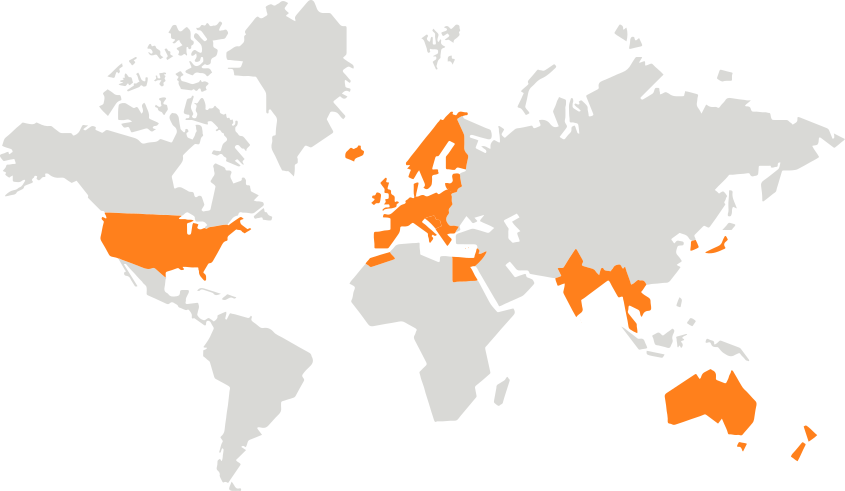
Our products are available through an extensive network of official resellers, ensuring accessibility and excellent customer service. Find your nearest reseller and explore our premium wood products today. Contact us for more information.