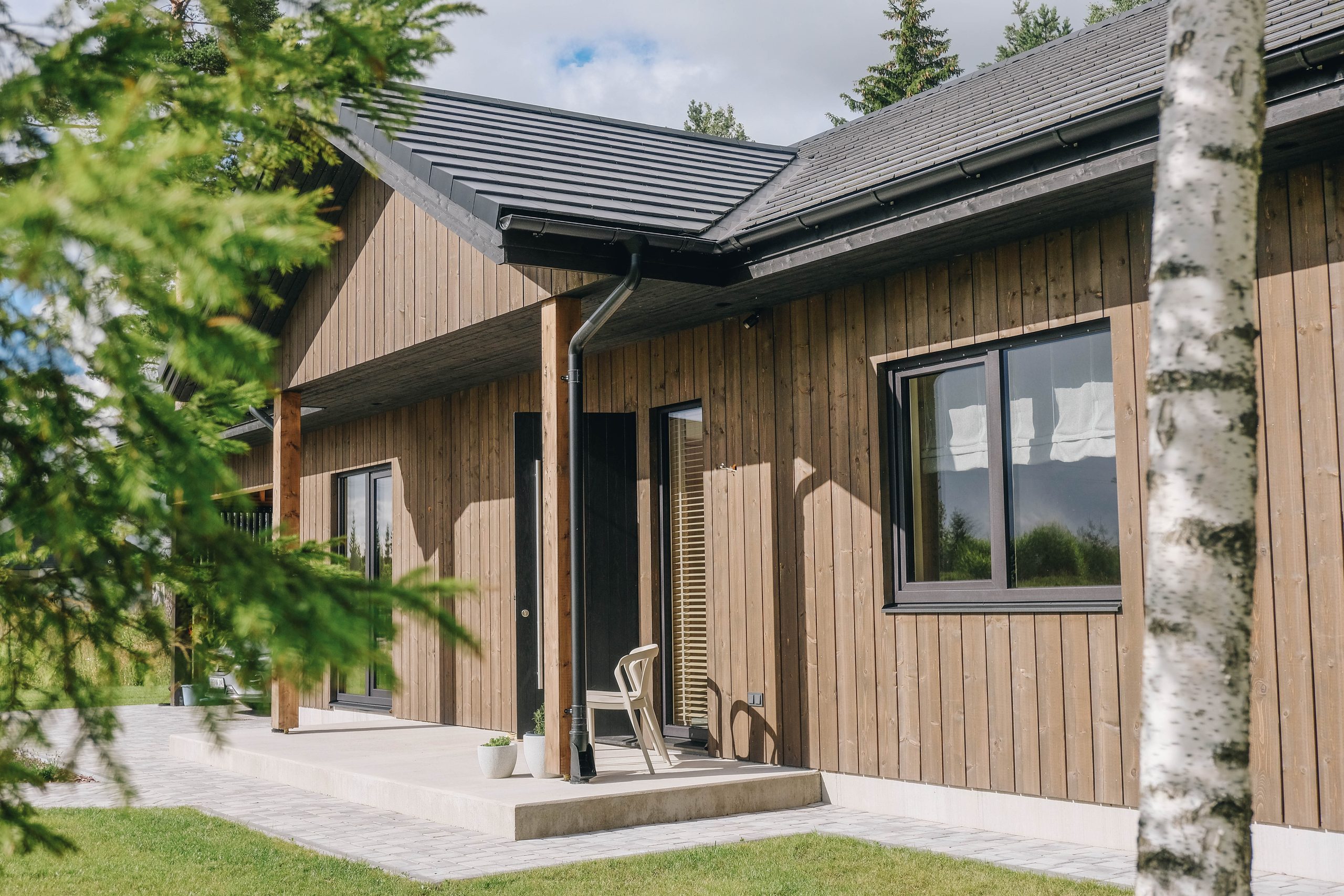
When choosing exterior timber cladding, colour is often the first thing people consider. In reality, the appearance and performance of a timber façade are shaped by several choices working together: the cladding profile, the width of the visible face, the surface treatment of the timber and the finishing system applied to it.
Changing just one of these elements can give the same building a noticeably different appearance. This is why exterior cladding profiles, surface treatments and finishes should be considered as a complete system rather than separate design decisions.
How does the cladding profile affect a timber façade?
The exterior cladding profile determines much of the visual rhythm and structure of a timber façade. The width of the board, the shape of its edges and the depth of the joint between boards influence how strongly the façade surface is divided.
Exterior cladding boards with a wider visible face generally create a broader and more uniform appearance. Narrower boards or more pronounced joints create a stronger rhythm across the façade. Profiles that form deeper shadow lines make the structure of the timber cladding more visible, even when viewed from a distance.
The profile should therefore be selected not only according to the appearance of an individual board but according to how the complete façade will look once the boards are installed together.
Vertical or horizontal timber cladding?
Installation direction is another important consideration when choosing exterior timber cladding. Vertical and horizontal cladding are not simply two different installation methods – they can change how the proportions of a building are perceived.
Vertical timber cladding can emphasise the height of a building and create stronger vertical lines. Horizontal timber cladding tends to emphasise width and creates a different visual rhythm across the façade.
The intended installation direction should therefore be considered when selecting a cladding profile. Not every exterior cladding profile is technically suitable for both vertical and horizontal installation.
Appearance is also only one consideration. The profile needs to support appropriate water drainage, secure connections and fixing while allowing sufficient ventilation behind the timber façade.
How does surface treatment change the appearance of timber cladding?
Surface treatment has a significant impact on the final appearance of exterior timber cladding. A smooth planed board reflects light differently from brushed or sawn timber, meaning that exactly the same colour can appear noticeably different depending on the surface beneath it.
Smooth planed timber creates a more uniform surface. Brushing makes the natural timber grain more prominent, while a sawn surface creates a stronger texture and places greater visual emphasis on the material itself.
This interaction between colour and texture becomes particularly important across a large timber façade. A shade selected from a small colour chart may look considerably different when applied across tens or hundreds of square metres of exterior cladding.
For this reason, it is advisable to assess a finished sample using the actual timber, cladding profile, surface treatment and chosen coating rather than selecting the finish based on a colour code alone.
Opaque or translucent finish for exterior timber cladding?
One of the main decisions when selecting a finish for exterior timber cladding is how much of the timber’s natural appearance should remain visible.
An opaque finish provides greater colour uniformity across the façade and reduces the visibility of natural colour differences between individual boards. The texture of the timber does not necessarily disappear, however. Brushed or sawn exterior cladding can retain a clearly visible surface texture beneath an opaque coating.
A translucent finish allows more of the natural character of the timber to remain visible. Grain, knots and natural colour variations continue to form part of the finished façade. As a result, individual boards finished with the same product and colour may still vary visually.
The performance and appearance of finished timber cladding are not determined by the topcoat alone. The complete finishing system matters, including timber preparation, priming where required and subsequent finishing coats. The appropriate system depends on the timber, surface treatment and conditions in which the cladding will be used.
What are the benefits of factory-finished timber cladding?
Factory finishing allows exterior timber cladding to be coated before installation under controlled production conditions. Coating application, quantity and drying can be managed consistently without relying on changing temperature, humidity or weather conditions on the construction site.
This becomes particularly valuable on larger timber façades, where consistency across the complete batch of cladding boards is important.
Factory-finished timber cladding can also reduce the amount of finishing work required on site. Instead of completing the entire coating process after installation, the project receives boards that have already passed through a controlled industrial finishing process.
Should you choose dark or light exterior cladding?
Exterior cladding colour affects more than the appearance of a building. Dark surfaces generally absorb more solar radiation and can reach higher temperatures in direct sunlight than lighter surfaces.
This is relevant for timber because changes in temperature and moisture affect the material. With particularly dark timber façades, correct fixing, ventilation and overall façade construction therefore require careful consideration.
Different sides of the same building can also experience very different conditions. A south- or west-facing façade exposed to stronger sunlight, wind and rain may age differently from a more sheltered elevation.
As a result, the maintenance requirements of exterior timber cladding cannot be determined by colour or coating alone. They depend on a combination of factors, including building location, façade orientation, construction, surface treatment, colour and the selected finishing system.
Why should cladding profile and colour be selected together?
Cladding profile and finish should be considered together because their interaction determines the final appearance of the façade.
A profile with a deep joint can create strong shadow lines when finished in a dark colour, while the same profile in a lighter shade may create considerably softer contrast. A wide, smooth cladding board can create a calmer overall surface, while narrower divisions and stronger timber textures can make the material itself a more prominent architectural feature.
Before making the final decision, it is therefore useful to compare physical samples of different exterior cladding profiles, surface treatments and colours. Where possible, assessing a larger sample area provides an even better indication of the final result because the rhythm, shadows and colour of timber cladding become much clearer when multiple boards form a complete surface.
How to choose the right exterior timber cladding
The right exterior timber cladding depends on the building and the result you want to achieve. Consider the architecture, cladding profile, vertical or horizontal installation, timber surface treatment, colour, finishing system and exposure to weather as interconnected choices rather than individual decisions.
For a more uniform façade, a wider profile, smoother surface and opaque finish may be suitable. Where the natural character and texture of timber should remain more prominent, a textured surface or translucent finish can create a different result. Technical requirements, including drainage, ventilation and fixing, should always be considered alongside appearance.
Puidukoda’s exterior timber cladding range combines different cladding profiles, surface treatments and finishing options. Instead of starting with one particular colour or profile, the selection can begin with the desired façade as a whole: how the surface should complement the architecture, how visible the natural character of timber should be and which finishing solution is appropriate for the intended conditions.
Ask our sales team about the different solutions and discover our exterior cladding range here.